



Call forWork
The second edition of Fields of Vision turns its gaze toward the shifting practices of contemporary photography. How are artists today reframing familiar terrains and narratives while still working in dialogue with the region’s deep visual and cultural histories?
This call seeks contemporary voices working from inside the place—whether geographically, emotionally, or conceptually—to engage with its evolving realities. In doing so, we ask: What new focal points emerge when we blur the edges between past and present, fact and fiction, documentation and imagination? How do shifting tools and technologies shape not only what we see, but how we see—and who gets to speak?
We invite work that tests the limits of what constitutes a photographic practice—whether through digital manipulation, moving image, archival intervention, artificial intelligence remixing, or hybrid forms—while remaining rooted in the landscapes, communities, and visual cultures of Central Illinois. How can such approaches reveal overlooked perspectives, challenge inherited tropes, or complicate established visual grammars?
Curated by Tim Hale
We invite photographers living, working, or whose practice engages with Central Illinois to participate in this exhibition. Our aim is to create a gathering place for the region’s photography community—one that fosters connection and exchange. This year’s show will be presented alongside a curated selection of zines, as well as prints from artists featured in last year’s Fields of Vision exhibition. Read more about the broader initiative.
Basics:
Exhibition Dates: November 21-December 7, 2025
Opening Reception: November 21, 2025
Venue: Analog, Urbana, USA
Benefits of Participation
Selected artists will have their work included in the annual Fields of Vision exhibition
Will be considered for inclusion in the ongoing Fields of Vision zine series published by Immaterial Books.
Accepted works may also become part of the growing Fields of Vision print collection, which will be displayed at future shows.
Selection Criteria:
We are seeking lens-based artists living, working, or whose work is focused on Central Illinois to participate in this exhibition.
Submission Guidelines:
Up to 10 still images (no video, installation, or AI-generated work)
Artist statement (250 words max) addressing how the work engages with the theme
Short bio (100 words max)
Deadline + Timelines:
Sept 21: Submission Deadline
Oct 5: Decisions Made and Sent Out.
Oct 26: Work is Due.
Send Submissions to:
Images from Last Year’s Exhibition


Zines from Fields of Vision Series

Here in rural southern Illinois, I see the same things over and over. Grain bins, baseball fields, cornfields, corn dogs, tractors, hay bales, farm houses, beer cans, churches, pork burger sales, and tank batteries. I photograph it all, I find the repetition comforting.
This work is inspired by the books of Ed Ruscha.
——————
Nathan Pearce is an artist based in Southern Illinois. Pearce works in book and zine making and photography. Pearce’s publications are held in several artists' book and library collections, including those at MoMA, The Met, Museum of Contemporary Photography, and the Center for Creative Photography. His work has been exhibited in solo shows at the PhotoNola festival, Cedarhurst Center for the Arts, Nizhniy Tagil Museum of Fine Arts, and The Rangefinder Gallery in Chicago. He has been published in over 200 books, zines, and exhibition catalogs and online in The Huffington Post, The British Journal of Photography, Juxtapoz, and Self Publish Be Happy.
——————
Edition: 100
Page Count: 26
Dimensions: 5.5”x8.5”
Format: Saddle Stitch / Zine
ISBN: 978-1-962415-10-1
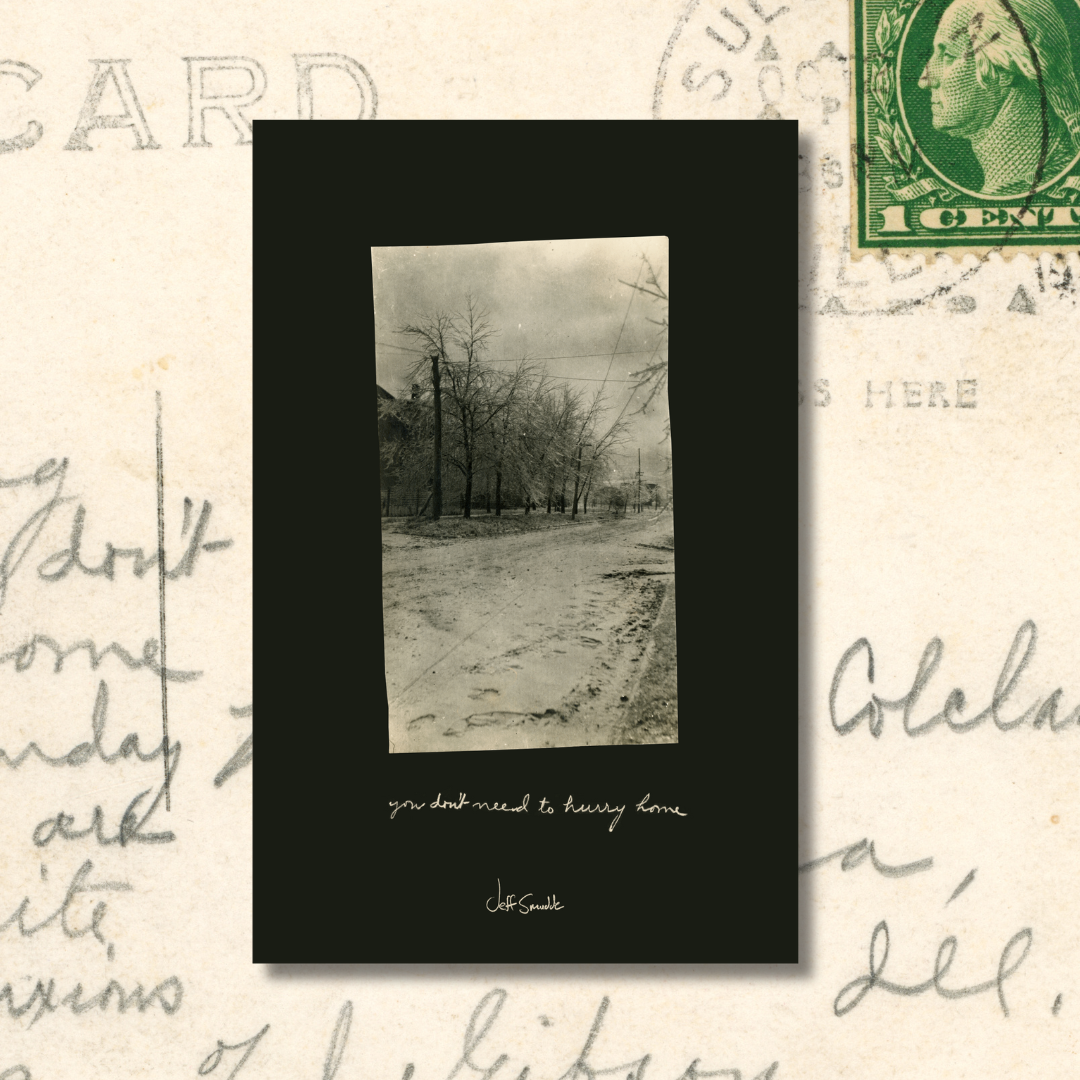
You Don’t Need to Hurry Home takes its name from a postcard sent in 1919 from Sullivan, Illinois, to Flora, Illinois. The postcard shows a rural road, likely in Sullivan, with telegraph poles overhead and frost-covered trees. Footprints and wheel tracks mark the lower third of the photograph, which was printed crookedly to adjust the image’s off-kilter angle. “We are getting along alright…” wrote the sender 106 years ago. “Write often as I am anxious…” This image captures an Illinois I hold dear, one I frequently photograph—the decaying rural spaces that have outlasted their time, the wooden posts and slats barely holding on, bullet-riddled signs, and barriers rarely performing their intended function. These photographs hold their subjects in perpetual tension, clinging to whatever they can, with the past permanently preserved within the frame.
——————
Jeff Smudde (pr. “SMOO-dee”; b. 1997, Metro Detroit, Michigan, he/him/his) is an artist currently based in the Providence, Rhode Island area using various photographic processes and sound. He received his Master of Fine Art at the University of Massachusetts Dartmouth in 2023 as a Distinguished Art Fellow and his Bachelor of Art from Illinois State University in 2019. His poetic documentary-style work comes from a background in journalism, a Midwestern cultural upbringing, and an interest in the landscape of America with a focus on perceptions of place and spirituality.
——————
Edition: 100
Page Count: 36
Dimensions: 5.5”x8.5”
Format: Saddle Stitch / Zine
ISBN: 978-1-962415-11-8
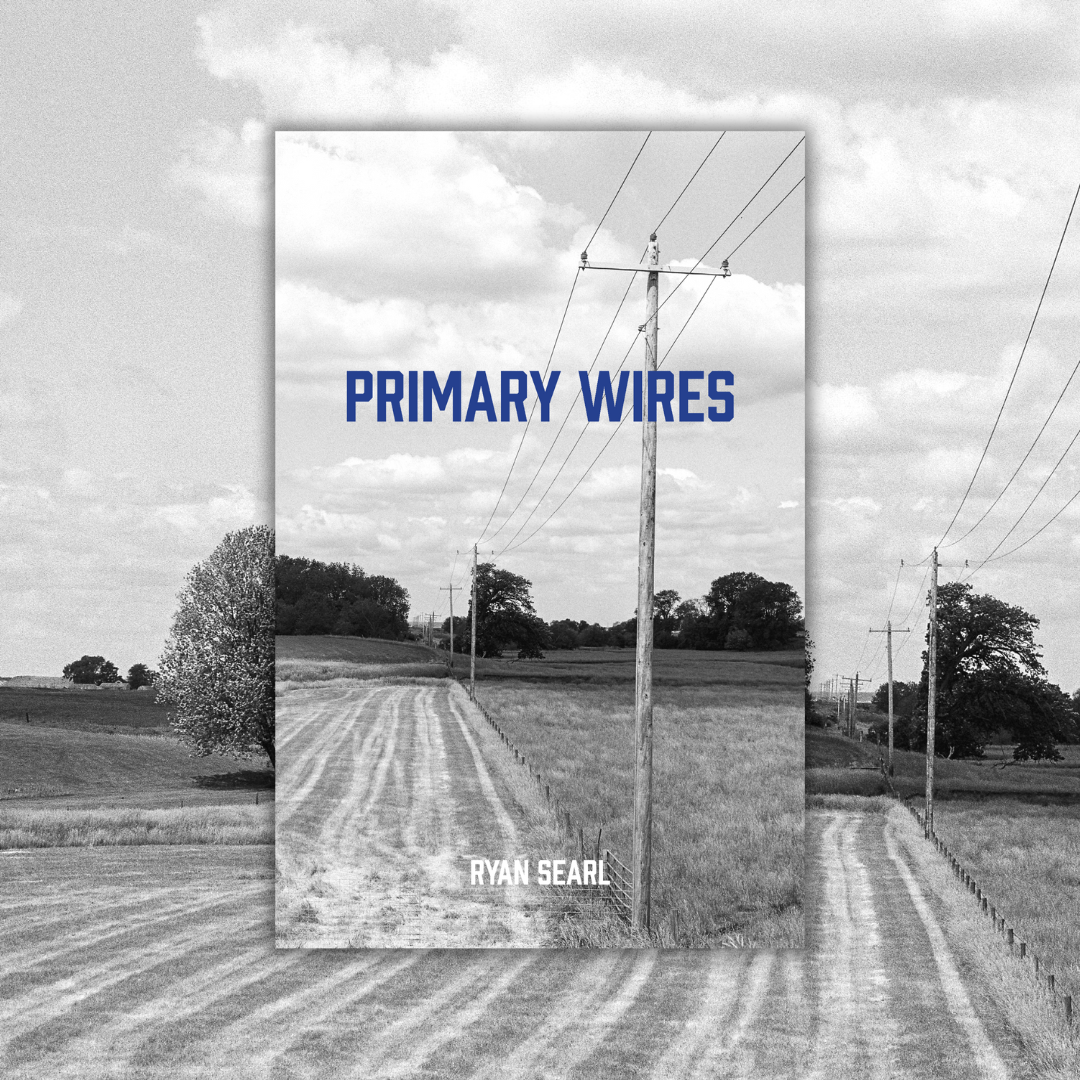
Being born and raised among some of the flattest land in the nation, utility poles and power lines became an early photographic fixation. Aside from the easy metaphors of connectivity, power, and the distribution of resources, these lines ebb and flow across flat Illinois farmland, from one horizon to another, in an undeniably moving manner. Primary Wires (named after the top-most pair of lines) feature just a few of the 180 million utility poles spread across the US.
——————
Ryan Searl (b. 1994) is a lens-based artist and photo zinemaker from Ottawa, Illinois. His work explores contemporary and underrepresented rural spaces in the tradition of regionalism and the FSA photo project. Searl's photography focuses on backroad midwestern communities that can often be characterized as too hermetic or flat for the American canon of post-documentary road trip photography, but hold a wealth of history, dignity, and unexplored stories. His work has been featured in Immaterial Book's “Fields of Vision” show and is in the collection of the Minneapolis College of Art and Design.
——————
Edition: 100
Page Count: 34
Dimensions: 5.5”x8.5”
Format: Saddle Stitch / Zine
ISBN: 978-1-962415-12-5

“Feedback is a method of controlling a system by reinserting into it the results of its past performance. If these results are merely used as numerical data for the criticism of the system and its regulation, we have the simple feedback of the control engineers. If, however, the information which proceeds backward from the performance is able to change the general method and pattern of performance, we have a process which may well be called learning.
Norbert Wiener. The Human Use of Human Beings: Cybernetics and Society (1950)
****
Machine Learning probes the interface between human perception and artificial intelligence by applying post‑industrial image‑making techniques to industrial and rural landscapes. Instead of relying on textual prompts, the project fed photographs into DALL·E’s first‑generation deep‑learning model—trained on some 400 million image‑text pairs— and challenged it to hallucinate entirely new interpretations of those scenes. These algorithm‑generated visions prompt critical reflection on emerging visual economies and the shifting locus of authorship: to what extent will creative agency reside with the human operator versus computational processes? What unforeseen visual realities might such synthetic re-imaginings disclose—realities beyond the reach of unaided human observation?
Machine Learning stages this inquiry, unsettling traditional notions of artistic production in an era increasingly defined by algorithmic vision.
——————
Phillip Kalantzis Cope is a Greek-born photographer, author, and cultural theorist based in Champaign, Illinois, USA. He bridges visual art and critical theory, exploring how digital media, property, and technology shape social life. His photography and scholarship are internationally published and exhibited, emphasizing human environments and the unseen narratives of everyday experience.
——————
Edition: 100
Page Count: 48
Dimensions: 5.8” x 8.3”
Format: Saddle Stitch
ISBN: 978-1-7355008-6-7
——————
PRESS / LINKS: